





How the Chess Pieces Move: A Beginner’s Guide
A clear guide to the board, every piece, special moves and your first practice routine
 Afro RookOctober 6, 20266 Mins read
 Learn the rules that make each square, capture and king decision count
Each piece has a fixed way to travel. A piece cannot move onto a square occupied by a piece of the same colour; if it reaches an opponent’s piece by a legal route, it captures it and removes it from the board.
The aim is to checkmate the king, meaning it is under attack with no legal escape. FIDE gives the movement rules; point values are only a guide.
The board and the starting position
A chessboard has 64 squares in an 8-by-8 grid, alternating between light and dark. Place it so the near-right corner is a light square: “light on the right” is the quick check. The vertical columns are files, labelled a through h from White’s left to right. The horizontal rows are ranks, numbered 1 through 8 from White’s side. Together, a file letter and rank number name one square, such as e4.
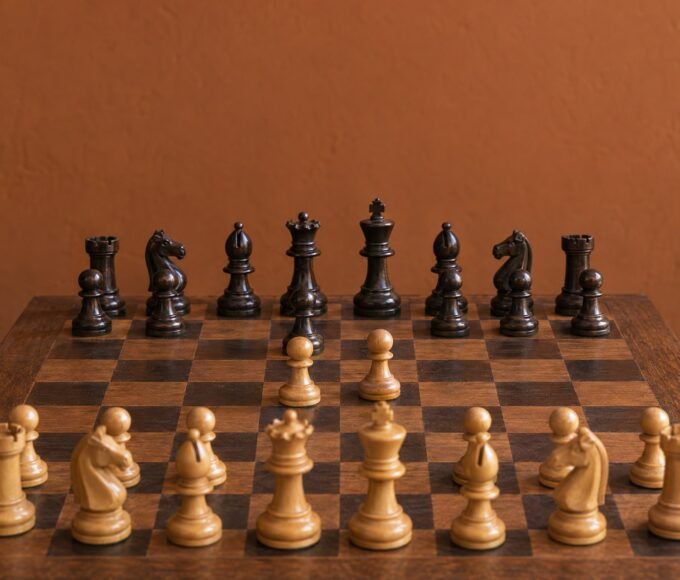
Each player starts with 16 pieces: one king, one queen, two rooks, two bishops, two knights and eight pawns. White’s back rank, from a1 to h1, is rook, knight, bishop, queen, king, bishop, knight, rook. Black mirrors this on rank 8. The queens begin on d1 and d8, while the pawns fill ranks 2 and 7.
Moves are commonly recorded in algebraic notation, the system that uses the square coordinates and an initial for most pieces. K means king, Q queen, R rook, B bishop and N knight; a pawn has no letter. Thus Nf3 means a knight goes to f3, while e4 means a pawn goes to e4. An x marks a capture, as in Bxe5.
The pawn moves differently
A pawn moves one square straight forward when that square is empty. White pawns move towards rank 8; Black pawns move towards rank 1. From its original square, a pawn may instead move two squares if both squares are clear. It cannot move straight forward into an occupied square, and it never moves backwards.
A pawn captures one square diagonally forward, not straight ahead. A White pawn on e4 attacks d5 and f5; if an opposing piece is on d5, exd5 is legal. The notation identifies the pawn’s starting file and capture square.
There are two special pawn rules. En passant is a capture available only immediately after an enemy pawn uses its first move to advance two squares and finishes beside your pawn. For example, after 1. e4 a6 2. e5 d5, White may play 3. exd6 e.p.: the pawn from e5 goes to d6 and removes the Black pawn that had just reached d5. If White plays another move first, that opportunity disappears.
Promotion happens when a pawn reaches rank 8 for White or rank 1 for Black. On that move it must become a queen, rook, bishop or knight of its colour; the new piece takes effect immediately, and it need not be a piece captured earlier. A pawn can therefore become a second queen.
A book cannot by itself teach how to play. It can only serve as a guide, and the rest must be learned by experience.
José Raúl Capablanca, former world champion
Knight, bishop and rook
The knight moves in an L: two squares along a rank or file, then one at a right angle, or one first and two at a right angle. It is the only piece that can jump over intervening pieces and captures only on its landing square. From e4 it can, for example, reach c5 or f2 if those destinations are legal.
The bishop travels any number of squares along a diagonal, provided no piece blocks the route. It never changes square colour, so each side has one light-square bishop and one dark-square bishop. A bishop on c1 can head towards d2, e3 and f4 when clear.
The rook travels any number of squares along a file or rank, but cannot jump. A rook on a1 moves along the first rank or up the a-file until the first obstruction. An open file has no pawns blocking it.
Their conventional values help compare exchanges, but they are not fixed scores: checkmate ends the game regardless of material.
| Piece | Conventional value | Main route |
|---|---|---|
| Pawn | 1 | Forward; captures diagonally |
| Knight | 3 | L-shaped jump |
| Bishop | 3 | Diagonals |
| Rook | 5 | Files and ranks |
| Queen | 9 | Files, ranks and diagonals |
| King | No conventional number | One square; must stay safe |
Queen and king
The queen combines the rook’s straight-line movement with the bishop’s diagonal movement. It travels any number of clear squares along a rank, file or diagonal, then may capture on its destination. It cannot pass through a piece. Its reach explains the nine-point convention, but an early queen sortie can lose time to attacks by smaller pieces.
The king moves one square horizontally, vertically or diagonally, and may capture only on a square that is not attacked. The king is never captured in a legal game: when attacked, it is in check and the player must move it, capture the attacker or block a line attack where possible.
You may not make a move that leaves your own king in check. A king cannot move next to the opposing king because each would attack the other.
Special moves, castling and king safety
Castling is the only move in which two pieces move during one turn. The king moves two squares towards an unmoved rook, which crosses to the adjacent square. Kingside castling is O-O; queenside is O-O-O. In O-O, the White king goes e1-g1 and rook h1-f1.
Castling is allowed only if the king and chosen rook have not moved, the squares between them are empty, the king is not in check, and it does not cross or finish on an attacked square. Moving the rook earlier loses that rook’s right even if it returns. Castling also brings a rook towards the centre.
The video line is legal and shows each move’s purpose: e4/e5 advance central pawns; Nf3/Nc6 develop knights; Bb5 develops the bishop and attacks c6, while a6 attacks it; Ba4 retreats, Nf6 develops; O-O moves the king e1-g1 and rook h1-f1; Be7 develops a bishop; Re1 moves that rook to the e-file. It has 12 half-moves.
A short practice routine
Begin with an empty board and place one piece at a time. Spend two minutes naming every square a knight on d4 can reach, then check: b3, b5, c2, c6, e2, e6, f3 and f5. Next, trace a bishop from c1 to the board edge, then stop a rook on a1 at an imaginary blocker.
Then practise captures with three positions. Place an opposing piece on a legal destination and say the move aloud, including the x: Bxe5, Nxf7 or Rxa3. Set up the en passant example and remember that the capture must happen immediately. Finish with five moves from the video line, checking each king and sliding path.
Frequently asked questions
Tap any question to open the answer.
Can a pawn capture the piece directly in front of it?
No. A pawn moves straight forward only to an empty square, but it captures one square diagonally forward. The exception is en passant, which still lands diagonally and removes a pawn from the adjacent square it has just passed.
Can a knight jump over a king or capture a piece it jumps over?
A knight can jump over intervening pieces, including friendly pieces or enemy pieces, because only its destination matters. It cannot capture anything it passes over; it captures only an opposing piece occupying its landing square. A move is still illegal if it leaves the knight’s own king in check.
Why can the king not be captured like a queen or rook?
The rules stop a player leaving the king under attack. That is check; if no legal answer exists, it is checkmate and the game ends before the king could be captured.






Related Articles
Caro-Kann Defence: A Solid Answer to 1.e4
Learn why the Caro-Kann Defence works, how its pawn structure frees Black’s...
How to Read Chess Notation Without Getting Lost
Learn the files, ranks and symbols behind algebraic notation, then use them...
King’s Indian Defence: a practical guide to Black’s attack
Learn the King's Indian Defence move order, closed-centre plans, ...e5 and ...f5...


Kasparov vs Topalov 1999: The Immortal Game
Study Kasparov vs Topalov 1999 at Wijk aan Zee: the opening surprise,...

Leave a comment