





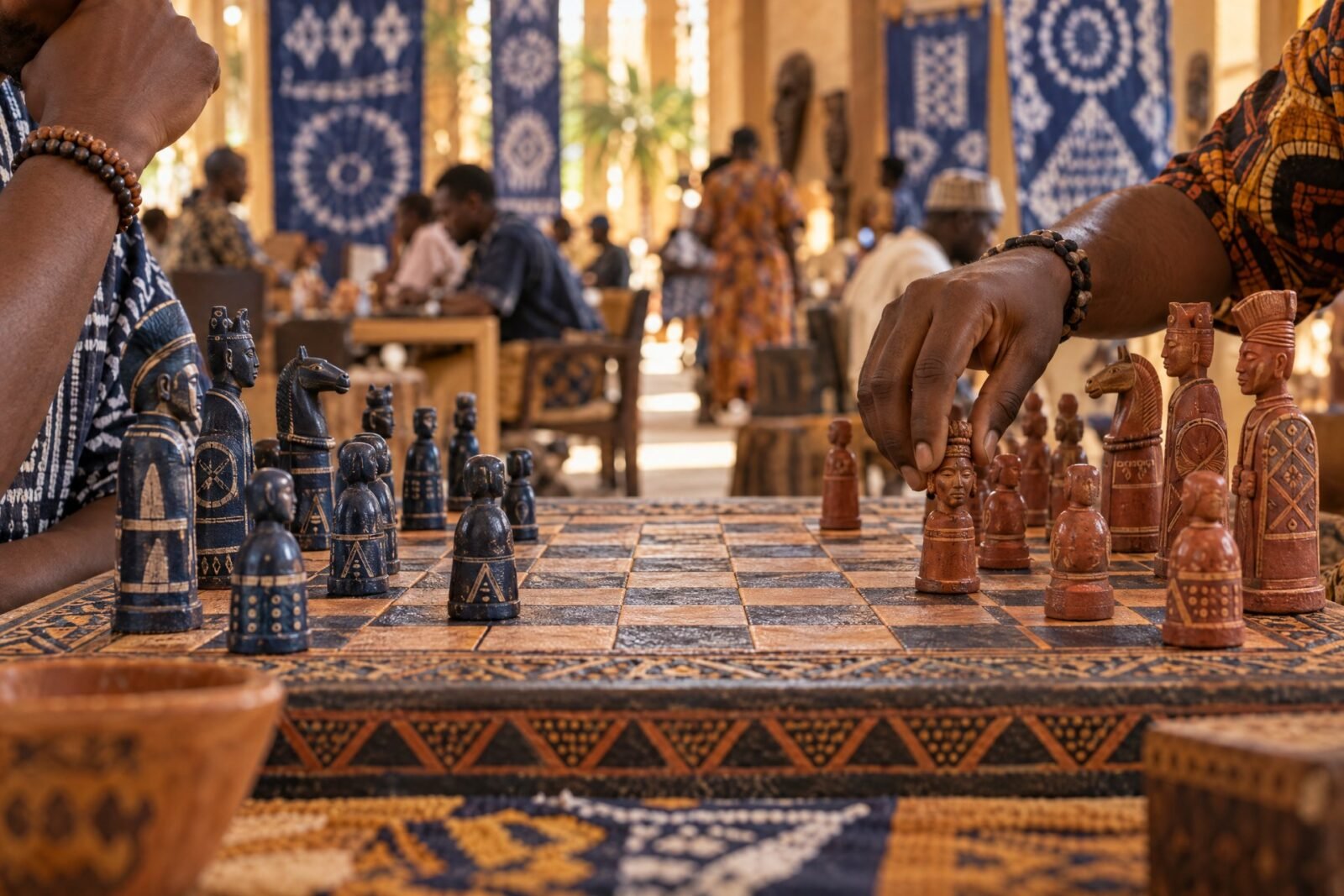
Adire, Nok and the board: Nigerian design meets chess
A practical look at how Yoruba textile practice and Nok terracotta can inspire playable, distinctly Nigerian chess equipment.
 Afro RookSeptember 14, 20266 Mins read
 What Nigerian craft can teach chess about pattern, form and place
A chess set is a playing tool before it is a display object, but its materials and visual language can still carry a sense of place. In Nigeria, Adire’s resist-dyed patterns and Nok culture’s terracotta forms offer two different, complementary ways to rethink the board without losing the game inside it.
Adire starts with process, not pattern
The Victoria and Albert Museum describes Adire as indigo-dyed cotton decorated through resist dyeing, traditionally made and worn by women across the Yoruba region of south-western Nigeria. The word means “tie and dye” in Yoruba. The technique dates to the 1800s, while the term came into use in the early twentieth century.
That history matters for chess design because Adire is not simply a blue-and-white print. Makers create the image by deciding where dye cannot enter. Raffia, starch, stitching, folding, tying and hand painting each leave a different kind of mark. Some methods produce circles; others make stripes, diamonds or blocks of fine line. The pattern is the record of an action.
A board inspired by Adire could therefore use variation without becoming visually noisy. The border might carry a restrained resist-dyed rhythm, while the 64 playing squares remain clear and even. A cloth board could be backed with a firm layer so it lies flat, or Adire could appear as an inlaid textile panel beneath a transparent, durable playing surface. In both cases, the craft should be visible as craft, not reduced to a generic “African” pattern.
The V&A also records that Adire continues to change. Contemporary makers use materials such as wax and paraffin as resists, and block printing has joined older stencilling methods. That continuing evolution gives designers permission to work with modern production, provided the maker, technique and community are acknowledged accurately.
Nok brings form and surface into the conversation
Nok culture presents a different design opportunity. National Geographic describes the Nok as one of the earliest known societies of Western Africa, existing in what is now Nigeria from around 500 BCE to 200 CE. The culture is known especially for terracotta sculptures and early iron working, although much about its society and origins remains unknown.
Nok sculpture is recognisable for details such as triangular or oval-shaped eyes and elaborate hairstyles. Human figures are often shown seated, with their hands on their knees. Those features should not be copied casually onto every chess piece. They are better understood as a lesson in silhouette: a small number of deliberate cues can make a form memorable from across a hall.
For a Nok-influenced set, the king and queen could be differentiated through height and posture rather than excessive ornament. Rooks might take a more architectural approach, while bishops and knights could share a family resemblance through their profiles. Terracotta would bring warmth and tactility, but a maker would need to test weight, stability and resistance to chipping before calling the set tournament-ready.
There is also an important ethical boundary. National Geographic notes that it remains unclear whether Nok art and metalworking influenced later societies such as Ife. A contemporary chess set can be inspired by the visual qualities of Nok terracotta without presenting an unproven line of inheritance as settled history.
Chess is a game by its form, an art by its content and a science by the difficulty of gaining mastery in it.
Tigran Petrosian, former World Chess Champion
Translating heritage into playable design
The rules create a useful discipline for the designer. FIDE defines the chessboard as an 8-by-8 grid of 64 equal squares, alternating light and dark, with a white square at each player’s near right-hand corner. Those requirements are not obstacles to local expression; they are the fixed frame within which material and ornament can work.
| Tradition or source | Design cue | Practical chess application |
|---|---|---|
| Adire resist dyeing | Indigo, negative space and repeated marks | Board border, carrying case, cloth underlay or square accents outside the playing field |
| Adire stitch and fold methods | Raised seams and controlled rhythm | Tactile trim, storage roll or a subtle edge pattern rather than crowded squares |
| Nok terracotta | Strong silhouette and warm earthen surface | Distinctive piece profiles, weighted bases or a sculptural display set |
| Nigerian mixed materials | Contrast between soft textile and hard clay | A coordinated set with textile packaging, board surface and fired pieces |
The central design question is legibility. A beautiful board that makes a bishop hard to distinguish from a knight has failed at its primary job. Contrast should be judged under the lighting found in Nigerian chess clubs, school rooms and tournament halls, not only in a carefully staged photograph.
Scale matters as well. Adire motifs can be enlarged, simplified or placed around the board instead of repeated inside every square. Nok-inspired pieces can keep a recognisable Staunton-like hierarchy while introducing local texture. The aim is not to disguise chess, but to give familiar functions a Nigerian material vocabulary.
A serious project would involve more than a mood board. It would include a Nigerian textile practitioner, a ceramicist or sculptor, a chess player and someone able to advise on cultural description. The maker should decide which patterns may be adapted, how the work is credited and whether the final object is for play, display or both.
A Nigerian chess set can be both beautiful and useful
The strongest design may be modular. A club could use a hard-wearing standard board for daily games, then add an Adire cloth cover for exhibitions and cultural events. A collector’s set could pair fired terracotta pieces with a flat, high-contrast board, while a school version could use painted wood or polymer to keep the weight and cost manageable.
That range also respects the difference between a craft object and competition equipment. Tournament players need pieces that stand securely, squares that remain readable and surfaces that tolerate repeated handling. A display set can take greater risks with height, texture and irregularity, as long as its purpose is stated clearly.
The best Nigerian chess design would make those choices visible. It would let a player notice the indigo logic of resist, the disciplined outline of a terracotta figure and the quiet order of an 8-by-8 board at the same time. Heritage would not be decoration added after the fact; it would shape how the object is made, handled and understood.
For Afro Rook readers, that is the invitation: look beyond imported boards when imagining the future of chess equipment. Nigerian designers already have rich answers to questions of colour, pattern, surface and form. The chessboard supplies the structure; local craft can give it character.
Frequently asked questions
Tap any question to open the answer.
What is Adire?
Adire is an indigo-dyed cotton textile tradition associated with the Yoruba region of south-western Nigeria. Its patterns are created by resisting dye with methods including tying, raffia, starch, stitching, folding and hand painting.
What is Nok culture known for?
Nok culture is known for terracotta sculptures and early iron working in what is now Nigeria. National Geographic describes characteristic facial features such as triangular or oval-shaped eyes, while also stressing that much about the culture remains unknown.
Can an Adire or Nok chess set be used in competition?
It can be designed for play, but appearance alone does not make equipment competition-ready. The board must preserve the required 8-by-8 layout and clear light-dark contrast, while pieces need stable bases, durable materials and unambiguous silhouettes.







Leave a comment