





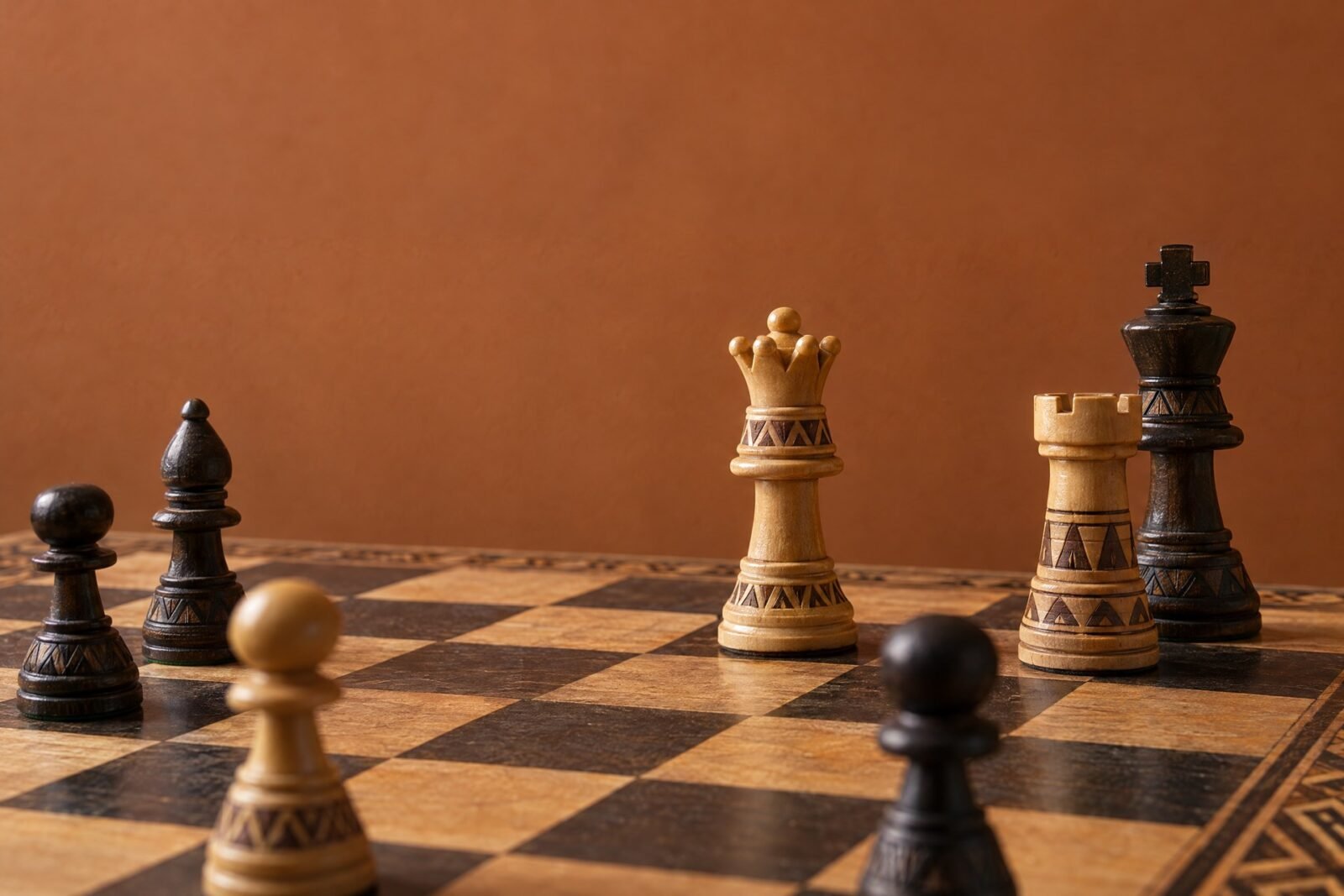
Kasparov vs Topalov 1999: The Immortal Game
How a quiet-looking Pirc became a 44-move lesson in calculation and king safety
 Afro RookOctober 8, 20266 Mins read
The famous rook sacrifice worked because every attacking piece arrived with purpose.
On 20 January 1999, in round four of the Hoogovens Tournament at Wijk aan Zee in the Netherlands, Garry Kasparov defeated Veselin Topalov 1-0. The game began as a Pirc Defence and ended after 44 moves, with Topalov’s king driven from a queenside shelter to d1. It is now widely known as Kasparov’s Immortal.
The score tells a more useful story than the nickname: Kasparov built pressure, calculated a forcing sequence and made each attacking piece useful before the rook sacrifice on move 24.
The setting and the surprise
Kasparov entered his first Wijk aan Zee tournament in 1999 and was leading jointly with Viswanathan Anand after three rounds. Topalov chose the Pirc, beginning with 1…d6 after Kasparov’s 1.e4. A Pirc Defence is an opening in which Black allows White to occupy the centre with pawns before challenging it with piece play and pawn breaks.
Kasparov later wrote that he had not expected Topalov’s choice. His annotation begins, “Nothing betokened a storm when I made this move.” White developed for an attack while both kings eventually castled queenside. The sequence was 1.e4 d6 2.d4 Nf6 3.Nc3 g6 4.Be3 Bg7 5.Qd2 c6 6.f3 b5 7.Nge2 Nbd7 8.Bh6 Bxh6 9.Qxh6.
The exchange on h6 removed Black’s g7 bishop and stopped short castling. After 10.a3 e5 11.O-O-O Qe7 12.Kb1, White’s king was safer on b1. Black replied 12…a6 and castled long with 13…O-O-O, leaving both kings on the same wing.
The centre becomes the battlefield
Topalov’s 14…exd4 was an important practical decision. By exchanging in the centre, Black reduced White’s space and opened lines for the pieces. Kasparov answered 15.Rxd4, putting a rook on the open d-file, then retreated it to d1 after 15…c5. The rook was not wasted: from d1 it supported the central files and kept pressure on d4.
The next manoeuvres crowded the queenside with targets: 16…Nb6 17.g3 Kb8 18.Na5 Ba8 19.Bh3. The knight attacked b7 and controlled c6, so Topalov struck with 19…d5 before White could improve every piece.
Kasparov met that break with 20.Qf4+. The queen moved to an active square with check, forcing 20…Ka7 and making the king leave b8. After 21.Rhe1, White placed the rook behind the e-pawn and prepared to use the e-file. Black pushed 21…d4, closing the centre and attacking the white knight on c3. Kasparov responded 22.Nd5, placing the knight in the centre and attacking key squares around the king.
| Move | What it does | Why it matters |
|---|---|---|
| 20.Qf4+ | Checks along the f4–b8 diagonal | Forces the king to a7 before the attack begins |
| 22.Nd5 | Centralises the knight with tempo against the position | Blocks Black’s coordination and supports e-pawn advances |
| 24.Rxd4 | Gives up a rook for the d4 pawn | Opens the e-file and clears the route for Re7+ |
| 25.Re7+ | Invades the seventh rank with check | Keeps the king moving and makes the rook untouchable for tactical reasons |
| 36.Bf1 | Places the bishop where it controls escape and capture squares | Forces Black’s rook to d2 and enables 37.Rd7 |
Nothing betokened a storm when I made this move.
Garry Kasparov, former world champion
Why 24.Rxd4 was the turning point
After 22…Nbxd5 23.exd5 Qd6, the position demanded a decision. Kasparov played 24.Rxd4, sacrificing the rook on d4. A sacrifice is a deliberate material concession for a concrete gain, such as an attack, a forced check or a mating threat. Here the rook removes the pawn on d4 and draws the c-pawn onto d4 after 24…cxd4.
The point is not that a rook is worth less than a pawn. The point is that Black’s pawn on d4 now blocks the black queen and helps open the e-file. White follows with 25.Re7+, using the remaining rook to invade e7. The check also attacks the queen on d6 along the seventh rank and denies Black time to consolidate.
Topalov could have declined the sacrifice with 24…Kb6, moving the king away and leaving White with a complicated but less decisive position. He instead chose 24…cxd4, the capture that made the celebrated combination possible. The move was legal and understandable over the board, but it allowed White’s checks to dictate the rest of the game.
The immediate tactical warning is 25…Qxe7. If Black captures the rook, White has 26.Qxd4+ and the king cannot escape the mating net. One verified line is 26…Kb8 27.Qb6+ Bb7 28.Nc6+ Ka8 29.Qa7 mate. The queen, knight and bishop cover the flight squares while the black pieces obstruct their own king.
The king hunt and the second wave
Topalov played 25…Kb6, keeping the queen and avoiding the immediate mate. Kasparov continued with 26.Qxd4+, sacrificing the knight on a5 after 26…Kxa5. The queen’s check pulls the king towards the centre, where 27.b4+ drives it to a4. White’s pawns are not merely material; b4 and later c3 take away the squares the king needs.
Kasparov played 28.Qc3, while later analysis identified 28.Ra7 as a stronger continuation. The game move still kept the attack alive after 28…Qxd5 29.Ra7 Bb7 30.Rxb7. The rook takes the bishop on b7, forcing 30…Qc4. White then removes the f6 knight with 31.Qxf6, while Topalov’s 31…Kxa3 grabs a pawn and tries to avoid an immediate check on a6.
The checks steer the king rather than seek a quick mate: 32.Qxa6+ Kxb4 33.c3+ Kxc3 34.Qa1+ Kd2 35.Qb2+ Kd1. The king reaches the first rank, but White’s queen controls the files and diagonals while Black’s rook and queen remain vulnerable.
The quiet move that finishes the calculation
At move 36, Kasparov played 36.Bf1. The bishop moves from h3 to f1, controlling the diagonal and making 36…Qxf1 impossible because 37.Qc2+ Ke1 38.Re7+ leads to mate after 38…Qe2 39.Qxe2. Black therefore played 36…Rd2, placing the rook on d2 between the king and the white queen.
Kasparov’s 37.Rd7 is the final tactical hinge. The rook moves to d7 and pins Black’s rook to the king’s line, while threatening Qxd2 mate. Topalov had to capture with 37…Rxd7. White answered 38.Bxc4, taking the black queen on c4 after the rook has been deflected; 38…bxc4 opens the b-pawn but cannot save the position. White then takes the h8 rook with 39.Qxh8.
The rest is technically clear: 39…Rd3 40.Qa8 c3 41.Qa4+ Ke1 42.f4 f5 43.Kc1 Rd2 44.Qa7, when Topalov resigned. The final queen move keeps the remaining pawns under control and leaves Black without a useful check or a way to stop further losses.
What the game teaches
The attack worked because it was coordinated. The queen gave checks from f4, d4, c3, a1 and b2. The knight’s jump to d5 restricted Black before being sacrificed. The rook sacrifice opened the e-file, while the second rook reached e7 and later d7. The bishop’s apparently modest 36.Bf1 was essential because it made the black queen’s capture unsafe.
The practical lesson is the difference between a calculated sacrifice and a hopeful one. Kasparov’s sequence was to remove the central pawn, invade with check, keep checking and use enemy pieces as blockers. It was prepared by 20.Qf4+, 21.Rhe1 and 22.Nd5.
For players studying the game in Nigeria, across Africa or in the diaspora, the useful question is not whether 24.Rxd4 can be copied, but whether a sacrifice changes the board’s geometry. Count checks, legal king squares and attacking pieces that can join with tempo.
Frequently asked questions
Tap any question to open the answer.
When and where was Kasparov vs Topalov played?
It was played on 20 January 1999 in round four of the Hoogovens Tournament at Wijk aan Zee, Netherlands. Kasparov had White and won 1-0.
What was the famous rook sacrifice?
It was 24.Rxd4. White’s rook captured the pawn on d4 and offered itself to the c-pawn. After 24…cxd4, 25.Re7+ began the forcing king hunt.
Could Topalov have refused the sacrifice?
Yes. The main published analyses identify 24…Kb6 as the safer way to decline the rook. Topalov instead played 24…cxd4, allowing the celebrated continuation.






Related Articles
Caro-Kann Defence: A Solid Answer to 1.e4
Learn why the Caro-Kann Defence works, how its pawn structure frees Black’s...
King’s Indian Defence: a practical guide to Black’s attack
Learn the King's Indian Defence move order, closed-centre plans, ...e5 and ...f5...
Alekhine–Nimzowitsch 1930: The Zugzwang Game
Follow Alekhine–Nimzowitsch, San Remo 1930, move by move: the French Winawer, Alekhine’s...


How the Chess Pieces Move: A Beginner’s Guide
Learn how every chess piece moves and captures, from pawn basics to...

Leave a comment