





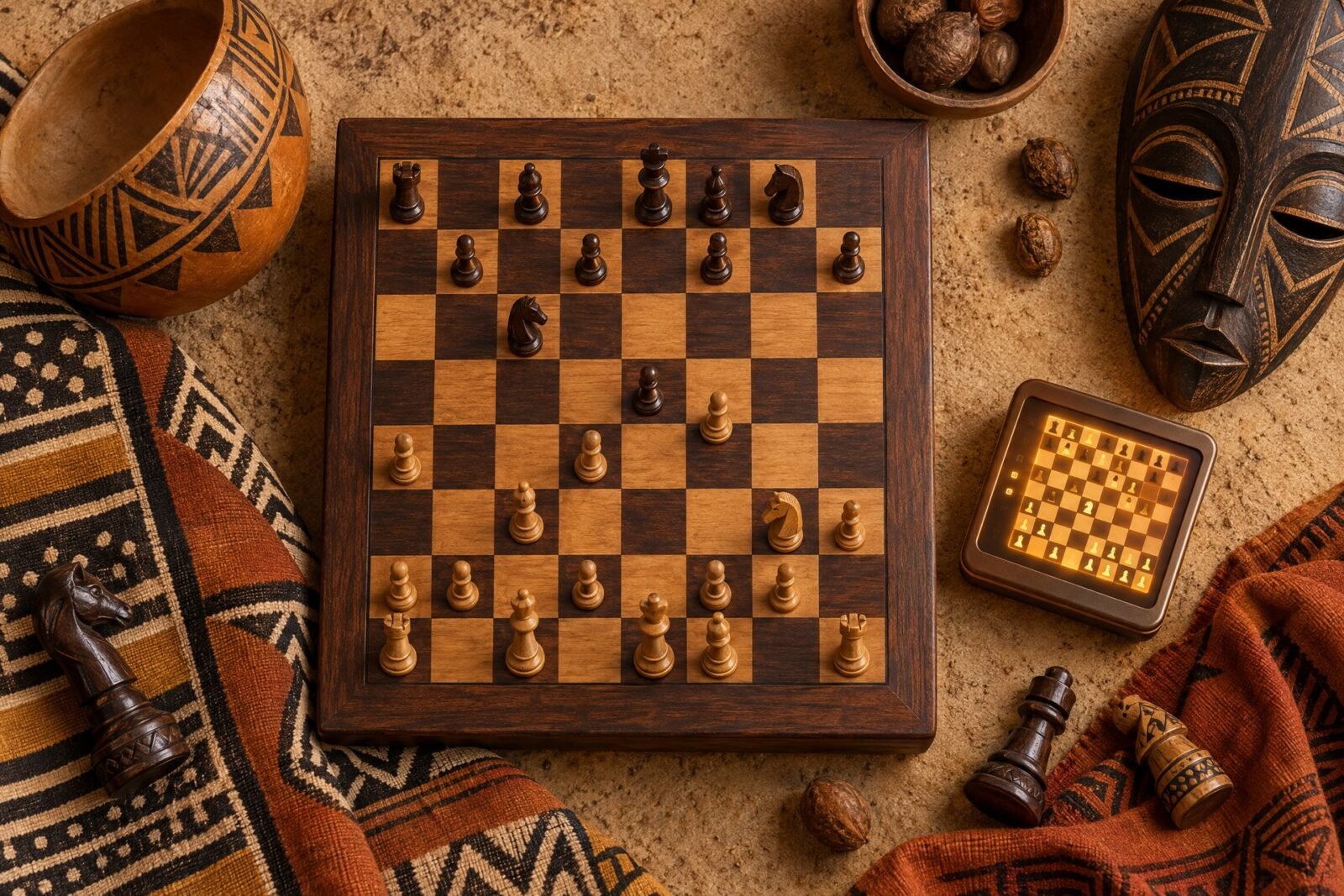
How Computers Changed Chess Forever: From Deep Blue to Stockfish
The machine moved from a supercomputer in a match hall to an open-source training partner for players everywhere
 Afro RookSeptember 15, 20265 Mins read
 From a 1997 shock to daily analysis on phones, the machine is now chess’s quiet partner
For centuries, chess was a contest between human memory, calculation and judgement. Computers first entered as laboratory experiments, then became match opponents, and now sit inside the phones used by players in Lagos, London and across the African diaspora. That journey did more than produce stronger opponents: it changed what people study, how they prepare and which positions they believe are playable.
From early programmes to Deep Blue
Computer chess began with modest ambitions. IBM records that its engineer and mathematician Alex Bernstein wrote a complete chess programme for an IBM 704 in 1957. A programme developed at MIT on an IBM 7090 followed in 1962 and was able to play regular chess credibly, but the machines were still far from grandmaster strength.
The project that eventually became Deep Blue began at Carnegie Mellon University under the name ChipTest. Feng-hsiung Hsu and his colleagues developed it into Deep Thought before continuing the work at IBM. IBM says Deep Thought became the first programme to defeat a grandmaster, a sign that the gap between specialist machines and elite human players was narrowing.
| Era | Machine milestone | Effect on human chess |
|---|---|---|
| 1950s–1960s | Complete programmes and credible play | Chess became a serious computing test |
| 1980s–1990s | ChipTest, Deep Thought and Deep Blue | Calculation and preparation became central |
| 1997 | Deep Blue won a match against Kasparov | The machine was accepted as a practical rival |
| 2008 onwards | Stockfish grew from an open-source project | Strong analysis became widely accessible |
Deep Blue’s first match against Garry Kasparov took place in Philadelphia in February 1996. The computer won the opening game, the first time a machine had beaten a reigning world champion under regular tournament conditions, but Kasparov won the six-game match 4–2. The result showed that a computer could win a serious game without yet being the better match player.
IBM rebuilt the system for a return match. The team improved its endgame databases and evaluation function, added advice from grandmasters and worked on ways to make its play less predictable. In May 1997, Deep Blue won the rematch 3½–2½, taking the deciding sixth game and becoming the first computer system to defeat a reigning world champion in a match under standard tournament controls.
Kasparov’s response, recorded by IBM, captured the shock of the moment: “The computer is far stronger than anybody expected.” He later described Deep Blue’s strength as the result of fast hardware, large databases and clever algorithms, rather than a human-like understanding of chess. That distinction still matters when players ask what an engine is actually telling them.
From specialist hardware to open source engines
Deep Blue was retired after its match with Kasparov. The next transformation was less dramatic but more important for everyday chess: powerful analysis moved from a corporate supercomputer to software that could be shared, improved and installed on ordinary devices.
Stockfish is a clear example. The project’s official history says Marco Costalba forked Tord Romstad’s open-source Glaurung 2.1 in November 2008 and introduced Stockfish 1.0. Joona Kiiski joined the project, and Stockfish is now maintained by a wider community. It is distributed under the GNU General Public License version 3, allowing users to share and modify it under the licence’s conditions.
Stockfish is not a chess app by itself. It is an engine that evaluates positions and searches for strong moves, communicating with chess applications through the Universal Chess Interface, or UCI. The official site lists desktop and mobile use, so the same engine can sit behind different boards, websites and training tools.
The computer is far stronger than anybody expected.
Garry Kasparov, former World Chess Champion and grandmaster
How human chess changed
Engines changed opening preparation first. Players could test old assumptions against calculation and identify defensive resources that were difficult to find over the board. Chess.com’s review of the engine era notes that stronger engines have made many previously doubtful openings look playable with accurate defence, while also pushing players towards subtler ways of creating winning chances.
That has altered what an opening is for. It is less often a promise of a forced advantage and more often a route to a position one player understands better. A surprise may be useful because it takes an opponent out of preparation, not because the engine calls it the top move. Human practical questions remain: who knows the plans, who can find the only defence and who is more comfortable with the resulting structure?
Modern engines also changed middlegame ideas. ChessBase reported that neural-network engines inspired by AlphaZero affected preparation, opening theory and strategic middlegame concepts. Their pattern-based evaluations encouraged players to look more closely at long-term pressure, space and piece activity, not only at immediate tactics.
The engine in your pocket
The pocket engine has changed the rhythm of learning. After a game, a player can see where an evaluation shifted, investigate an alternative and replay the critical position. A coach can use the same tools to ask better questions, but the most useful lesson is usually the reason behind a move rather than the move alone.
This access is especially significant where coaching resources are unevenly distributed. A young player in Nigeria or a member of the diaspora can study the same public engine code and analysis interface used by stronger players elsewhere. It does not remove the need for books, mentors, tournament experience or patient calculation, but it lowers one barrier to serious study.
There is also a boundary between preparation and play. In a tournament, an engine belongs in analysis before or after the game, not beside the board during it. Computers changed chess forever because they became part of how players think about the game, while decisions in a regulated game still have to be made by the person sitting at the board.
Frequently asked questions
Tap any question to open the answer.
When did a computer first beat a reigning world champion in chess?
Deep Blue won a game against Garry Kasparov in 1996 under regular tournament conditions. It then defeated him in their six-game rematch in May 1997, winning the match 3½–2½.
What is Stockfish used for?
Stockfish analyses chess positions, evaluates candidate moves and searches for strong continuations. It works with chess applications through UCI and is available across desktop and mobile platforms.
Do engines make human chess unnecessary?
No. Engines are stronger at sustained calculation, but human players still choose plans, manage the clock and handle psychological pressure. The modern skill is learning to interpret engine analysis and turn it into decisions that work against another person.





Related Articles

How the World Chess Championship Cycle Actually Works
The world title is not won in one tournament. Follow the FIDE...

Leave a comment