





Many of life’s failures are people who did not realize how close they were to success when they gave up.
Thomas A. Edison
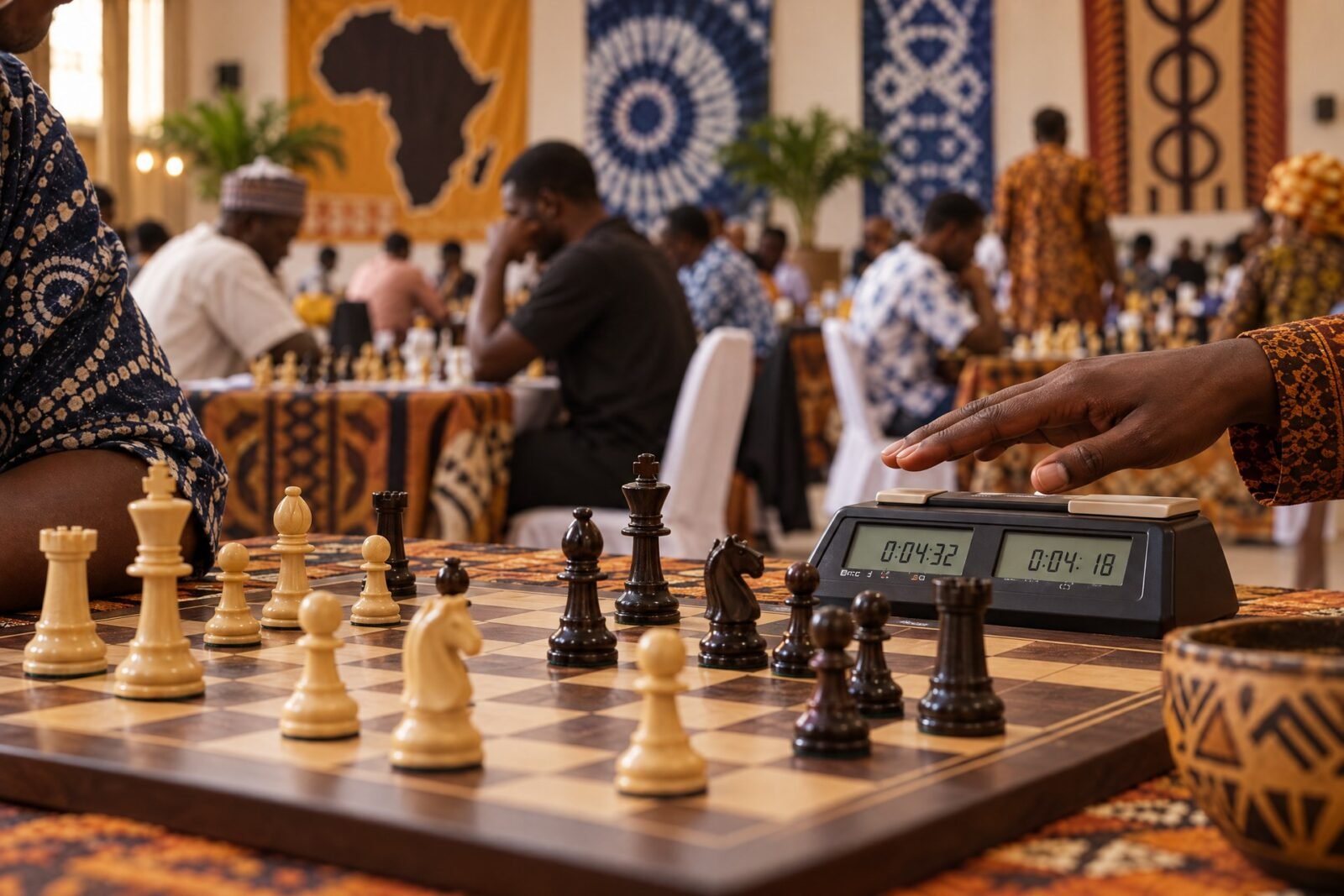
The clock is a piece: time management in tournament chess
From the first move to the final seconds, a repeatable routine helps you spend time where the position demands it.
 Afro RookSeptember 26, 20265 Mins read
 Strong tournament chess is also the art of spending time well
A tournament game is played on two boards: the wooden board in front of you and the clock beside it. Your position can be winning, drawable or lost, but the result still depends on making the required moves before your time expires. Good time management is therefore not simply playing quickly; it is deciding which positions deserve your attention and which moves can be made with confidence.
What the clock changes
The clock turns every decision into a practical choice. A move may be strong in a quiet position, but spending several minutes to confirm what you already know can leave you without enough time for the tactical crisis that follows. The useful question is not “How little time can I use?” but “What does this position require from me?”
A position deserves a longer think when the pawn structure is about to change, a forcing sequence is available, a king is exposed, or several candidate moves have different consequences. By contrast, a familiar recapture, a forced reply or a move that improves your worst-placed piece may not need a long investigation. This is not permission to play on autopilot: even a quick move needs a brief blunder check.
Daniel Naroditsky made a similar point in his practical writing on time management: speed is not the same as good clock use. His advice to slow down when winning or when lost is especially useful in over-the-board play. When ahead, use spare time to check for tactics and stalemate; when worse, search for real defensive resources instead of rushing in the hope that the opponent will panic.
Know the clock before move one
Before the round starts, read the time control and confirm how the clock is set. FIDE’s Laws define a chessclock as two connected displays, with only one running at a time. They also require the time control, including any additional time per move, to be specified in advance. If you do not know whether your game uses increment or delay, ask the arbiter before play begins.
| Clock detail | What it means at the board | Practical response |
|---|---|---|
| Main time | Your initial thinking time | Protect enough for the critical phase |
| Increment | Extra time added after each move | Keep making sound moves; do not treat it as unlimited time |
| Delay | A fixed period before main time runs down | Know whether the display includes or excludes the delay |
| Flag fall | Your allotted time has expired | Check the display before committing to a move |
In a Fischer or cumulative increment, time is added after each move. The amount can help you recover from a short think, but it does not erase the time already spent. A player who burns the main time in routine positions can still reach a difficult endgame with an uncomfortable clock, even when every move brings a bonus.
The rules matter physically as well as strategically. Under FIDE’s Laws, the move is not complete until you have pressed your clock, and the time between moving a piece and pressing the button counts against you. Use the same hand to make the move and press the clock, keep your finger off the button until the move is made, and practise this motion before an important event.
When my opponent’s clock is going I discuss general considerations in an internal dialogue with myself. When my own clock is going I analyse concrete variations.
Mikhail Botvinnik, former World Chess Champion
Think on both clocks
Your opponent’s thinking time is part of your thinking process. You cannot calculate every line reliably while also watching the other player, but you can prepare useful information: which of your pieces is least active, what your opponent is threatening, which exchanges might help, and which replies you would consider if the expected move appears.
Botvinnik’s distinction is a powerful discipline. On the opponent’s time, build a map of the position and identify ideas for both sides. On your own time, calculate the concrete variations that decide whether a move works. If your opponent plays something unexpected, stop and reset rather than automatically playing the reply you prepared.
A simple routine helps. First ask what changed after the opponent’s move. Then check checks, captures and direct threats. Next choose a small number of candidate moves and compare their consequences. Finally, before moving, ask what your opponent can do immediately after your choice. This sequence is short enough to use in a rapid game and robust enough for a long tournament game.
Do not confuse thinking with staring. If no concrete question is being answered, return to the position’s features: open files, loose pieces, pawn breaks, king safety and the least useful piece. A clear question such as “What is my opponent threatening?” is more valuable than another minute of unfocused calculation.
Survive time trouble
Time trouble begins before the display reaches its final seconds. It is already a problem when you realise that every remaining move must be made in a hurry. Set private checkpoints during the game: after the opening, at the first major tactical decision and before an expected endgame. At each checkpoint, note whether you are spending too much time on routine choices and whether the position is approaching a forcing phase.
When the clock is low, simplify the decision rather than abandoning thought. Look for forcing moves first, then reject moves that lose material or allow an immediate tactic. If two moves appear close, prefer the one you understand and can execute safely, unless a concrete calculation proves it fails.
Increment changes the arithmetic, not the need for discipline. A few seconds added per move can support a sequence of accurate decisions, but it cannot rescue repeated hesitation or a move that was never checked. Use the increment to breathe, verify the opponent’s threat and make the next good move; do not spend it automatically on every position.
Practise the endgame skills that most often collide with the clock. Naroditsky’s advice includes learning basic checkmates and rehearsing their quickest safe execution, because technical knowledge prevents a winning game from becoming a race against the flag. In training games, set a time control similar to your next event and review not only the blunders, but also the moments where you spent time without narrowing the choice.
Frequently asked questions
Tap any question to open the answer.
Should I try to keep the same amount of time as my opponent?
No. The clocks are a warning system, not a race to match the other display. Spend more time when your position contains concrete danger, but notice when routine moves are quietly draining your reserve.
Is it safe to play quickly when I have an increment?
Increment gives you additional time after a move, but it does not make careless decisions harmless. Use the bonus to check the opponent’s reply and keep a steady rhythm, especially when the position is tactical.
What should I do when I have only a few seconds left?
Prioritise legal, forcing and safe moves, and make the clock action part of your physical routine. If the position is winning, avoid unnecessary complications; if it is worse, look for the most active defence rather than moving randomly.





Related Articles
How to Calculate: Find Candidate Moves Like a Stronger Player
Stop calculating the first attractive move. Learn a practical candidate-move routine that...


How to Study Your Own Games and Improve Faster
Playing more games gives you experience, but reviewing them turns experience into...

Leave a comment