





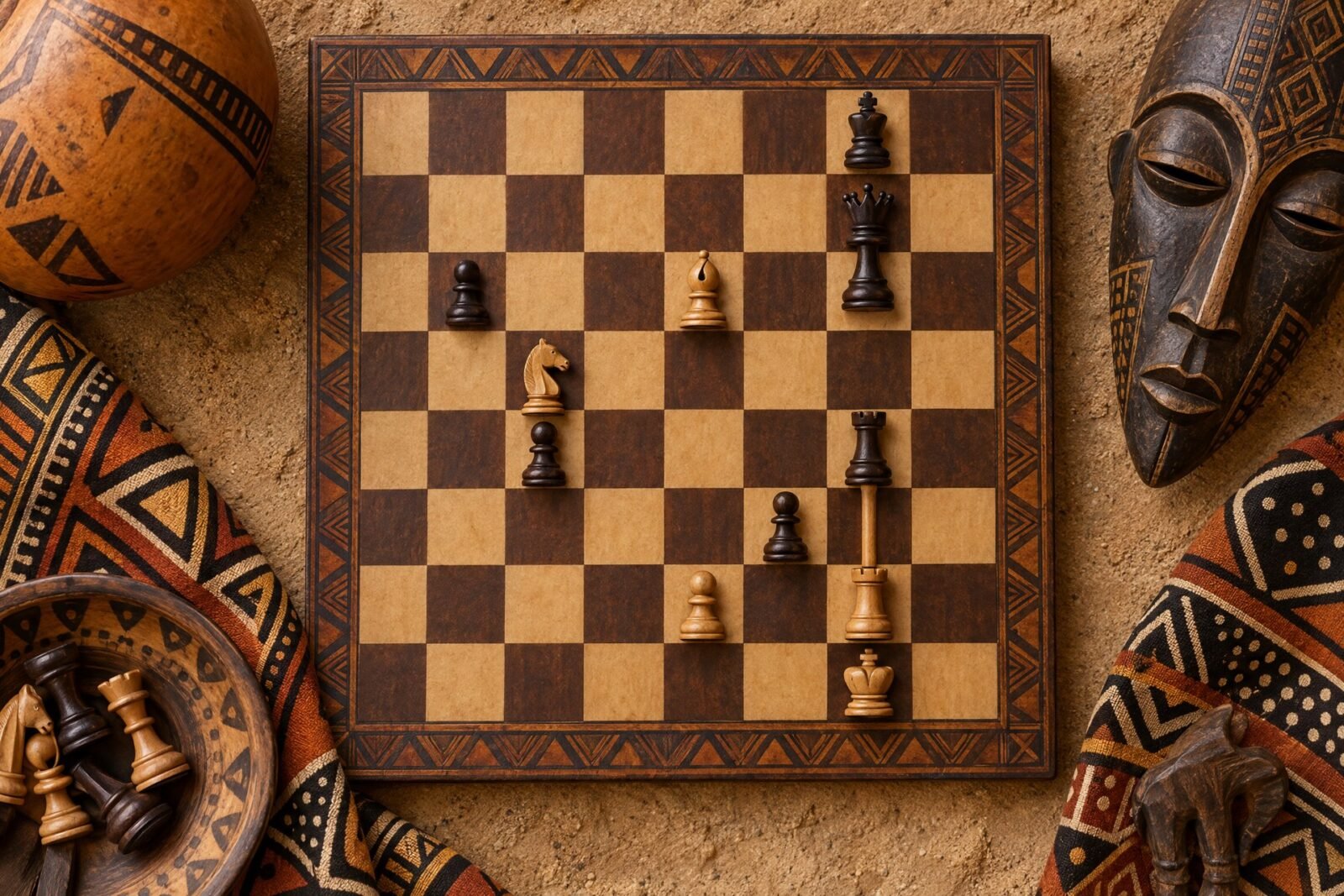
Forks, Pins and Skewers: Three Tactics for Club Games
Three simple patterns turn loose pieces and aligned targets into winning chances, if you know what to scan before every move.
 Afro RookOctober 5, 20265 Mins read
 Read the board, find the alignment, and make the forcing move
A tactical win rarely begins with a spectacular sacrifice. More often, it starts when a player notices that two enemy pieces are exposed, lined up or unable to move freely. Forks, pins and skewers are three reliable patterns for turning that observation into material.
The ideas are simple enough for a beginner, but they reward disciplined calculation at every level. The key is not to hunt for a pretty move; it is to ask what your move attacks, what your opponent must answer, and what remains loose afterwards.
Tactics start with forcing questions
In chess, a tactic is a move or sequence that creates immediate threats and forces the opponent to concede something. That concession may be material, a mating attack or a defensive resource. These patterns are different from a long-term strategic plan because the gain is meant to appear through a concrete, short-term threat.
Before looking for a named tactic, scan the board in three directions. Look for enemy pieces that sit on the same rank, file or diagonal; look for a valuable piece behind a less valuable one; then check whether one of your pieces can attack two targets at once. Do not stop at the first attractive move. Tarrasch’s advice in the quote above is a useful calculation habit: after finding a candidate, test whether a stronger forcing move exists.
| Pattern | What is in front? | First question to ask |
|---|---|---|
| Fork | One piece attacks two or more targets | Can one move attack two valuable pieces? |
| Pin | A less valuable piece blocks a valuable one | What happens if the blocker moves? |
| Skewer | A valuable piece is attacked in front of a lesser one | Where will the front piece move, and what is behind it? |
Forks: one move, several targets
A fork is a move in which one piece attacks two or more enemy pieces at the same time. It is a form of double attack, and the usual practical problem for the defender is that one move cannot answer every threat. Knights are especially effective because they jump over intervening pieces and can attack targets that look safely separated.
Imagine a knight moving to a central square with check while also attacking a rook. The king must deal with the check first, giving the knight time to take the rook on the next move. That is the classic checking fork. A pawn can also fork two pieces on its diagonals, while a queen can fork along several lines, although a queen fork must be calculated carefully because the queen may be captured.
To spot a fork, start with forcing moves. Examine every check, capture and direct threat, then ask whether the moving piece attacks a second target from its destination. Do not limit the search to two pieces: a fork may combine a piece attack with a mating threat, or attack a king and a piece together.
When one sees a strong, even a decisive move, one must always ask oneself if there is not a still stronger one.
Siegbert Tarrasch, German chess master and theorist
Pins: make a blocker do too much
A pin uses a line-moving piece—the bishop, rook or queen—to restrict an enemy piece because something more valuable is behind it. The front piece is not always legally trapped, but moving it may expose the valuable target to capture. If the target behind is the king, the pin is absolute: moving the pinned piece would leave the king in check and is illegal.
For a simple example, place a rook on an open file with an enemy knight between it and the enemy king. The knight cannot step away while the line remains open, so the rook has gained more than a normal attack. If the piece behind is a queen or rook rather than the king, the pin is relative. The defender may move the front piece, but doing so can lose material.
Spotting a pin begins with line awareness. Check bishops on long diagonals, rooks on open files and queens on either kind of line. Then identify what lies beyond the first enemy piece. A pinned piece may still defend another square, capture the attacker or move along the line, so do not assume it is helpless without checking the exact position.
Skewers: attack the valuable piece first
A skewer also attacks two pieces on one line, but the order is reversed from a pin. The more valuable piece stands in front and is attacked directly; a less valuable piece waits behind it. When the front piece moves to safety, the attacker can take what it was shielding.
A bishop giving check to a king with a queen behind it is the cleanest example. The king must move out of check, and the bishop can then capture the queen if no legal defence changes the result. A rook can similarly attack a queen with a rook or minor piece behind it, forcing the queen to choose a square while exposing the rear target.
To find a skewer, trace every bishop, rook and queen line towards a valuable enemy piece. Ask whether a second target sits directly behind it, and whether the first target has a legal escape that does not save the rear piece. Checks are particularly strong because the defender must answer the check, but a relative skewer against a queen can also win material.
Do not treat every alignment as automatic. The rear piece may move first, the attacked piece may capture the skewering unit, or the defender may gain time with a check of its own. Sometimes a tactical counter-threat changes the result, so calculate the opponent’s strongest reply before claiming the piece behind.
Frequently asked questions
Tap any question to open the answer.
What is the quickest way to tell a fork from a pin?
A fork is about one piece attacking multiple targets from its new square. A pin is about a line attack restricting a piece because something more valuable lies behind it. If the key question is “what two things are attacked now?”, look for a fork; if it is “what is this piece shielding?”, look for a pin.
Can a pawn make a fork?
Yes. A pawn can attack two enemy pieces on the two diagonals in front of it, so an advance or capture may create a fork. Because a pawn is less valuable than the pieces it attacks, the tactic can remain useful even if the pawn is later captured.
Are skewers always winning?
No. The attacked front piece may move with a check, capture the attacker or create a stronger threat, and the rear piece may have a defensive resource. A skewer is a promising alignment, not a result; calculate the legal replies before taking the exposed material.







Leave a comment